The Future of Podcasting is Women
New research reveals a significant disconnect between what audiences want and what the industry currently provides, positioning women as the untapped engine for future growth in Europe.
.png)
On a recent Saturday in Milan, we stood before a room full of creators, producers, editors, and journalists at Tutte Abbiamo Voce (“We All Have a Voice”). Looking out at the crowd, the energy was undeniable: the European podcasting scene is powered by a dynamic mix of women professionals, particularly across the Italian and Spanish markets.
But as we presented our latest "Women in Podcasting" 2026 Research, a stark paradox emerged. While women are at the heart of podcast consumption and engagement, they remain critically underrepresented and underfunded.
The data tells a story of high demand and low supply. Our research shows that the industry is struggling to keep pace with its own audience:
- Representation: 40% of European listeners believe the podcast industry fails to represent women adequately as hosts.
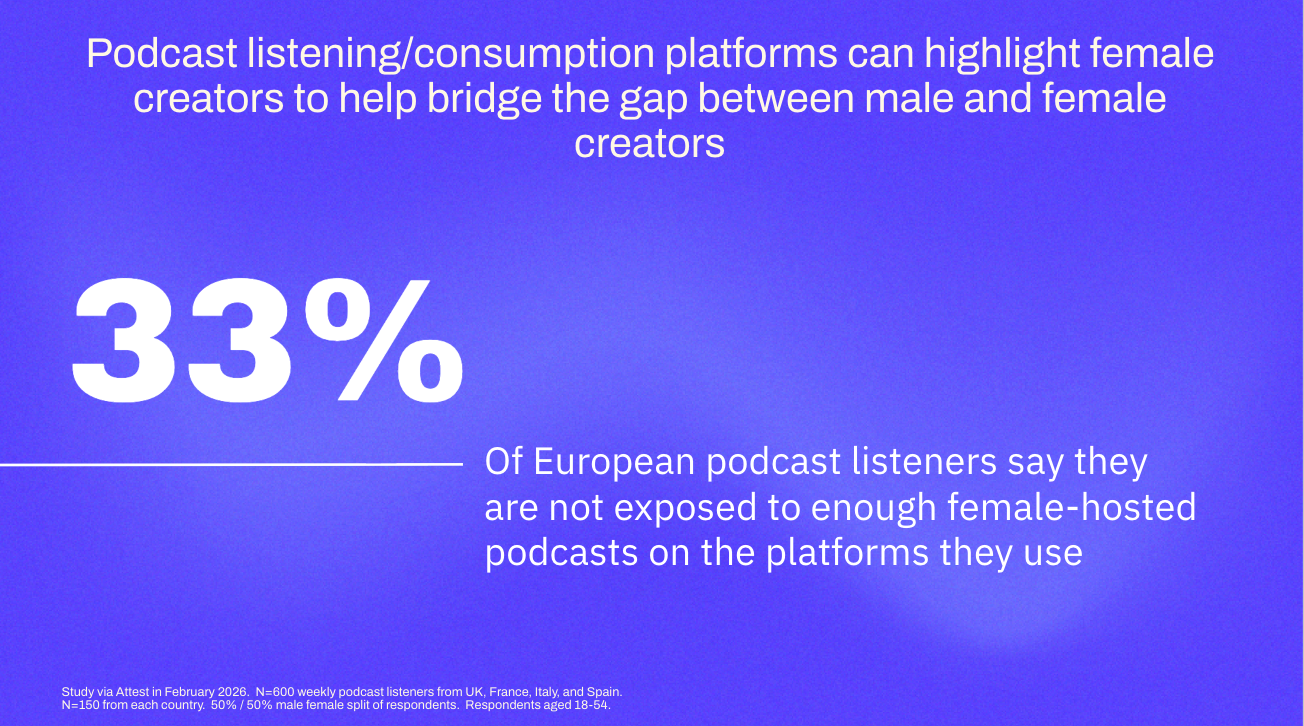
- Discovery: 33% of listeners report they aren't exposed to enough content hosted by women on their preferred platforms, noting that algorithms still tend to favour male creators.
- Demand: This isn't just a "women’s" issue. One-third of male listeners and two-fifths of women listeners are now actively seeking out podcasts hosted by women.
As noted in Corriere della Sera, while women are often the catalyst for a podcast's success, the "mic" is still disproportionately held by men. We are effectively leaving a massive portion of the audience underserved.
Why Women are an Advertiser’s Best Bet
The intimacy of podcasts creates a "trust dividend" that women hosts are uniquely positioned to exemplify:
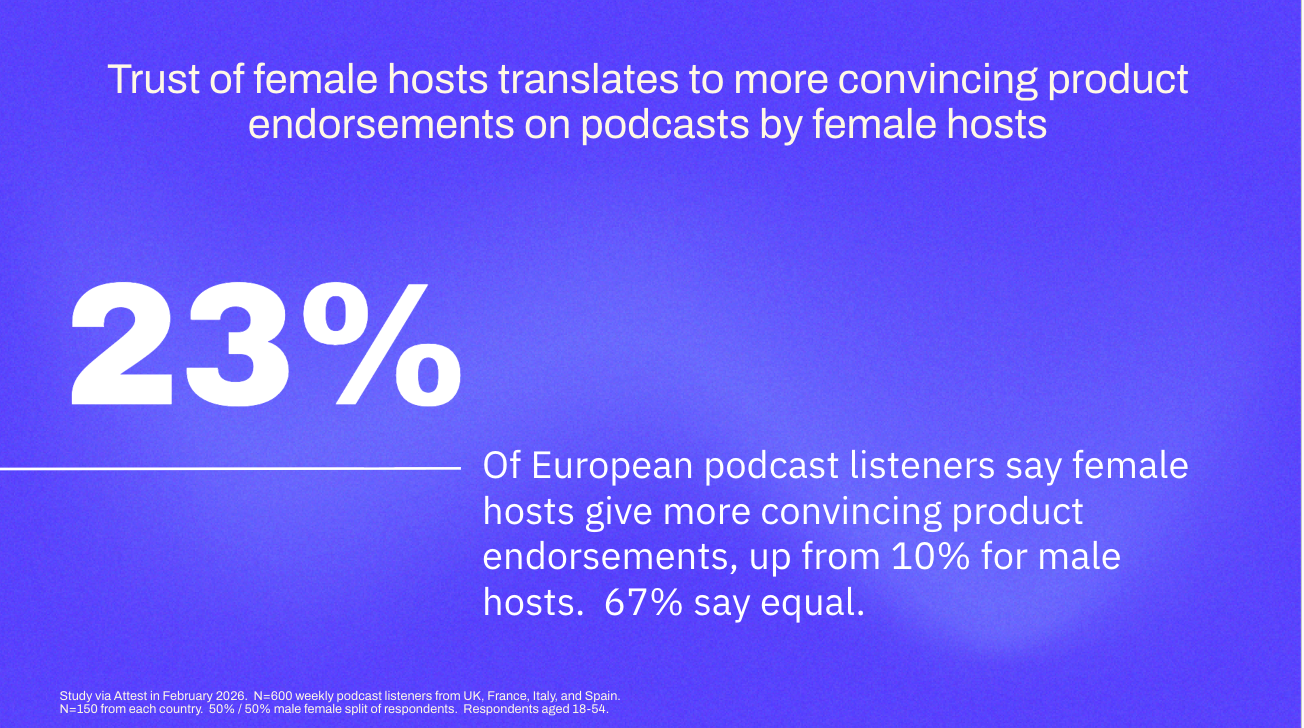
- Persuasion: Listeners find product endorsements from female hosts significantly more convincing (23%) than from male hosts (10%).
- Perspectives: 63% of European listeners say women hosts bring valuable, different perspectives.
- Opportunity: There is an opening for women’s voices in traditionally male-skewed genres like Sports and Tech, where listeners are hungry for fresh, diverse commentary.
Making Women’s Voices Economically Sustainable
Advocacy is a start, but sustainability is the goal. At the event, we discussed how to turn these insights into a thriving business model. To make women’s voices economically sustainable, we must focus on:
- Evolution: Moving beyond the standard "spot" to host-read sponsorships that leverage the deep parasocial trust women hosts build with their fans.
- Cross-Border: The attendance of Italian, Spanish, French, and Belgian professionals at Tutte Abbiamo Voce highlights the power of a unified European ecosystem. By sharing data and talent across these borders, we create a larger, more attractive scale for global advertisers.
- Platforms: Listening platforms must do more. If 1 in 3 listeners can't find the women’s voices they want, the industry is failing to meet its own growth projections.
What’s Next?
The success of the first Tutte Abbiamo Voce proved that the hunger for change is real and that we expect future events in the years to come. The follow-up conversations we’ve had since the event show an industry ready to move from awareness to action.
In 2026, the future of podcasting belongs to those who recognise that diversity is a competitive advantage. With 77% of European listeners calling for more women behind the mic, representation is no longer just a goal - it’s a mandate. We’re committed to ensuring women’s voices are loud, heard, and, most importantly, economically empowered.
If you’re a woman in podcasting - a creator, advertiser, producer, or any role in between - and would like to discuss representation, commercial viability, or advertising in Italy, Spain, or wider Europe, please get in touch with megan@acast.com and joanna@acast.com.
Note on Research: Study conducted via Attest in February 2026. N=600 weekly podcast listeners from the UK, France, Italy, and Spain (N=150 per country). 50/50 male/women split of respondents, aged 18-54.
