Podcasting's Future Is Free-Flowing
Acast CEO Greg Glenday's keynote speech at The Podcast Show 2026
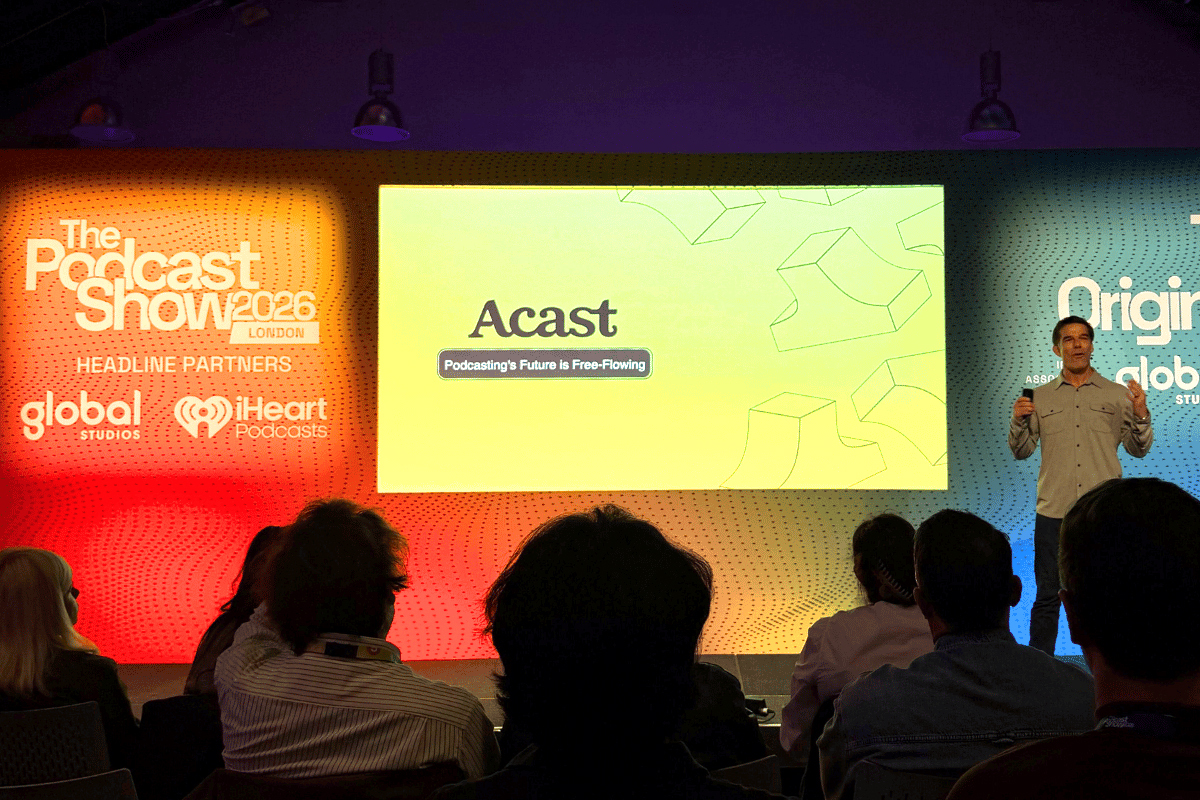
I gave a keynote at The Podcast Show in London this week, and I want to say something upfront: the energy in that room was different. Not just different from previous years - different in a way that felt genuinely significant. The optimism, the collaboration, the sense that we are collectively standing at the edge of something great. I walked away more convinced than ever that podcasting is not just surviving the chaos of a rapidly shifting media landscape. It is defining what comes next.
So let me share what I told that room - the data, the ideas, and a few things I think our industry needs to say out loud.
Narrative Influence: The Superpower We've Been Sitting On
At Acast, we talk a lot about what makes podcasting special. But "special" is a word that can feel like empty marketing if you can't back it up. So let me back it up.
We believe that what podcasters have built with their audiences is unlike anything else in media. We call it narrative influence - and it doesn't matter whether you're watching on your sofa or listening while you walk the dog. The power comes from the story, the conversation, the relationship between a creator and their audience. That's the signal. The format is just the channel.
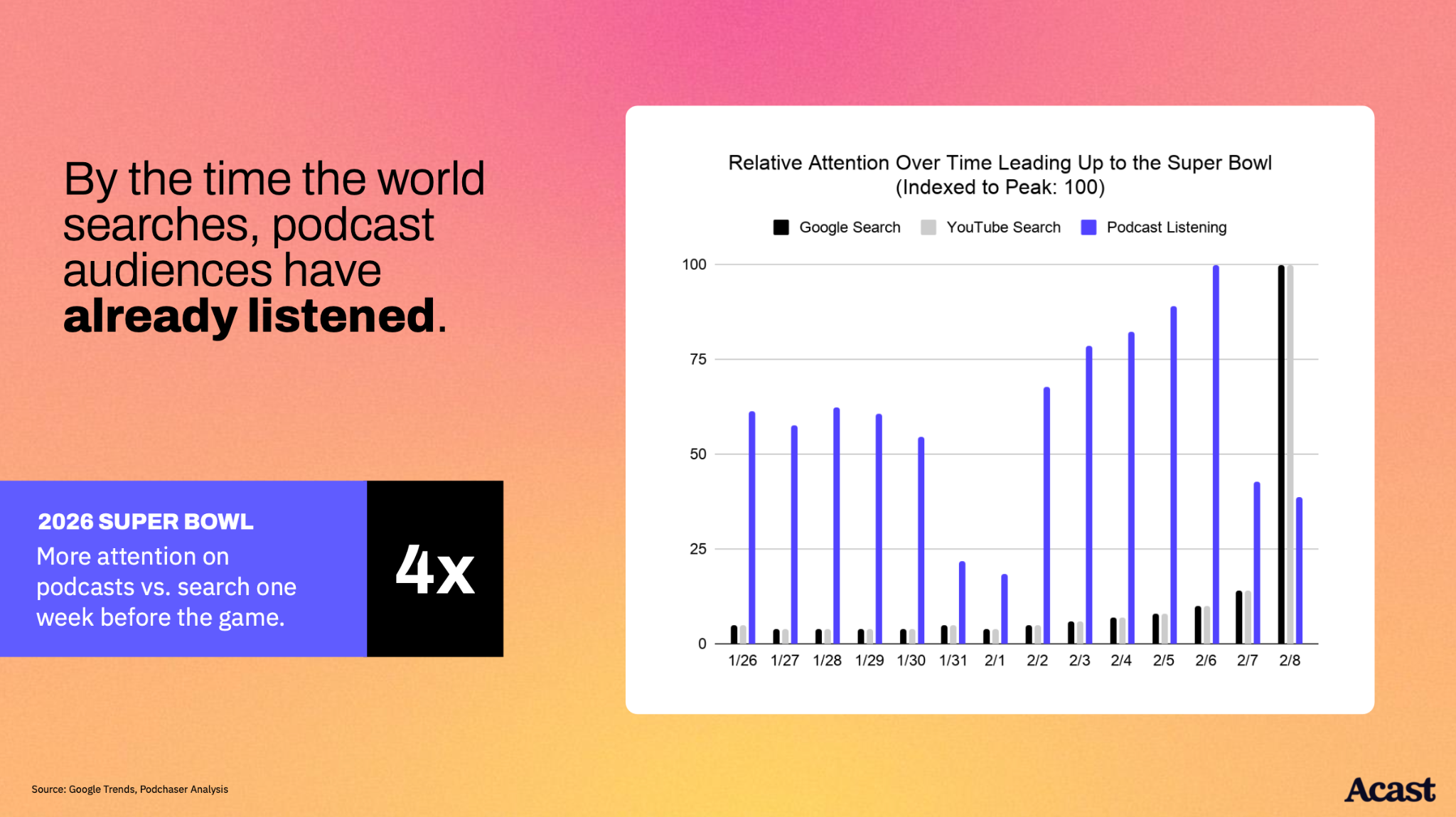
Here's one way to see this in black and white. If you look at the conversation data around major cultural events - the Super Bowl, the Oscars, even the lead-up to the war in Iran - podcasting is where the conversation starts. Weeks before the peak of public attention, podcasters are already in the thick of it, unpacking it, framing it for their audiences. By the time brands are scrambling to buy a slot in a crowded, expensive cultural moment, podcasting has already been having the conversation.
That is an enormous, largely untapped opportunity for the brands willing to think differently about where they show up.
Brands are Missing the Real Conversation
We’re sitting on data that I think challenges some deeply held assumptions in the industry - and in the advertising world.
Take food delivery brands. We looked at 170,000 mentions across 12,000 unique podcasts and over a billion data points. What we found: food podcasts account for less than 1% of mentions of food delivery companies. Yet food podcasts were receiving roughly half of the ad spend from food delivery brands. That's a fundamental mismatch.
Why? Because delivery is not a food passion behavior. Delivery is a time-management solution. If someone is listening to a Michelin-starred chef talk about the art of cooking, they are not in the headspace to order Deliveroo. But a parent podcast, a productivity show, a comedy about the chaos of modern life? That's where the audience actually is. We can see it in the data. Brands just need to trust it.

We also looked at AI. In Q1 2026, we analyzed 75,000 podcast episodes and found that mentions of the major AI companies were up 51% compared to the whole of the second half of 2025. In a single quarter. This is a live, moving cultural conversation - and these companies are largely absent from it.
The sentiment data is where it gets really interesting. Take Anthropic. The parent company carries significant negative sentiment in podcast conversations - associated with ethics concerns, military connections, questions about its role in the world. But Claude, its consumer product, carries strongly positive sentiment: productivity, usefulness, a tool that helps people do their jobs. Same company. Radically different narratives. And both of those narratives are being shaped by podcasters right now, whether Anthropic is in the room or not.
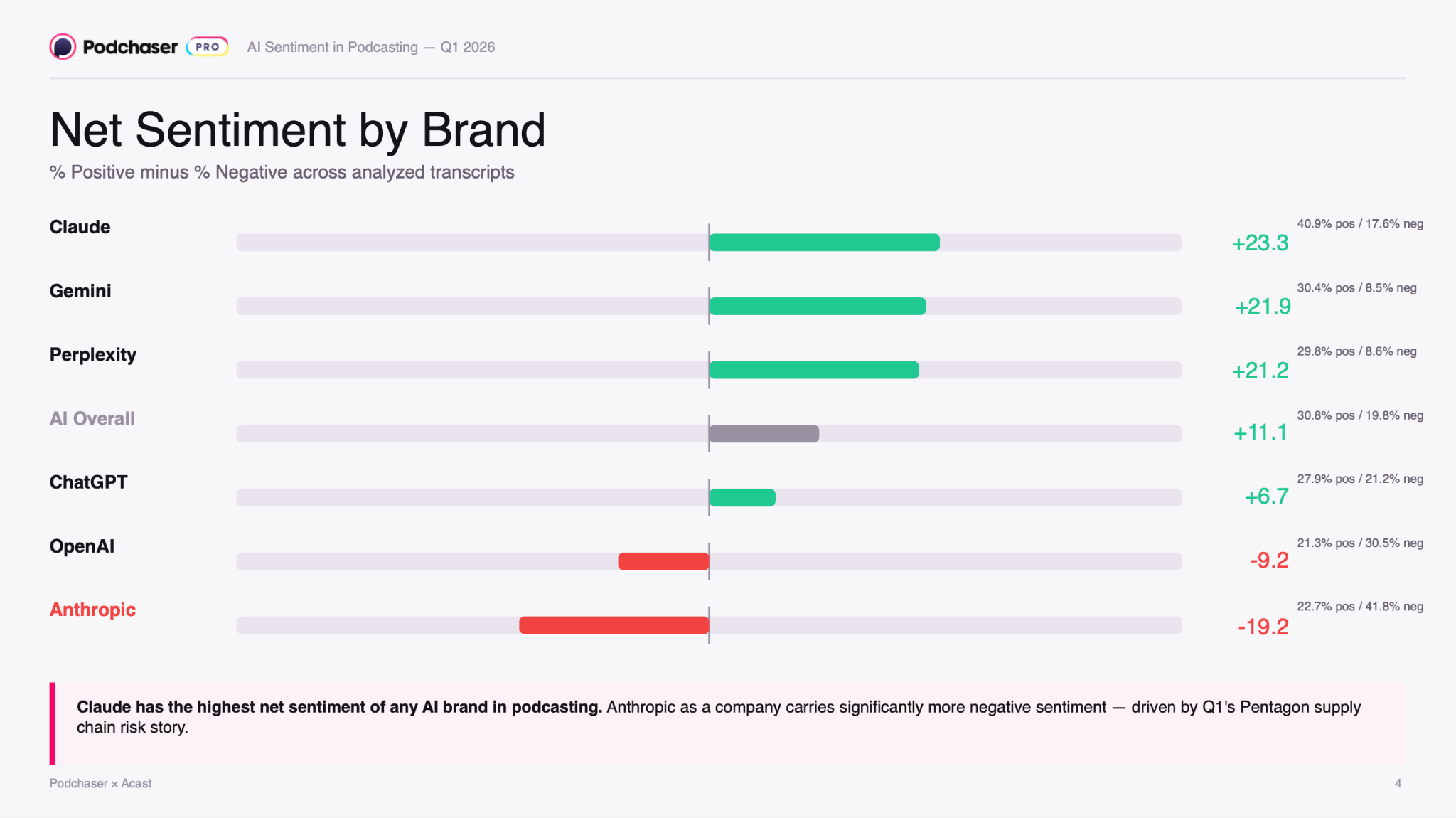
The question for any brand is: do you want to participate in the conversation that's already happening about you, or not?
The Influencer Paradox
Our annual Podcast Pulse research throws up a number of figures I love, but there's one that stops me every time.
75% of weekly podcast listeners do not consider podcasters to be influencers. But 84% say they have been influenced by a podcaster.
That tension is the whole story.
"Influencer" has become a loaded word in advertising, and for good reason. We've all seen the supermodel holding the sandwich. Nobody believes she ate it. The performance of endorsement, disconnected from genuine opinion, has eroded trust in that entire category of marketing.
Podcasters are something different. 64% of listeners say they trust podcast hosts to give genuine endorsements. 70% say a recommendation from a podcaster made them consider a brand they'd never heard of before. Two thirds have discovered new brands or products through podcasts and now view those brands positively.
And this: 85% of daily podcast listeners have taken some form of brand action after consuming a podcast. Among 18-to-34-year-olds - the most ad-skeptical generation in history - 73% have made a purchase from a brand they first encountered through a podcast in the last 12 months.
I have two kids in that age range. I know how hard it is to get their attention, and how much harder it is to earn their trust. These numbers matter.
The analogy I keep coming back to is this: Times Square is full of people trying to get your attention. Billboards, lights, noise, a slightly unsettling Mickey Mouse. You walk through it with your wallet in your front pocket and your eyes down. Then you go meet your best friend at a pub, and he tells you you'll love a film he just saw. You trust him completely. You go see the film.
Podcasters are that friend. For millions of people, every single day.
Where We Are on Video - And Why It's an Opportunity, Not a Threat
Two years ago, video felt like a storm on the horizon for podcasting. Everyone was anxious. Now we're here, and the storm turned out to be a wave we can actually ride.
The reality is that podcasting is and has always been multimodal. Some people exclusively listen. Some people now only watch. Most of us are somewhere in between - I'm a commuter and a frequent traveler, so I'm mostly audio, but I'll watch on a long flight or a train journey. That's not going to change. The research suggests this continuum is a permanent feature of how people consume podcasts.
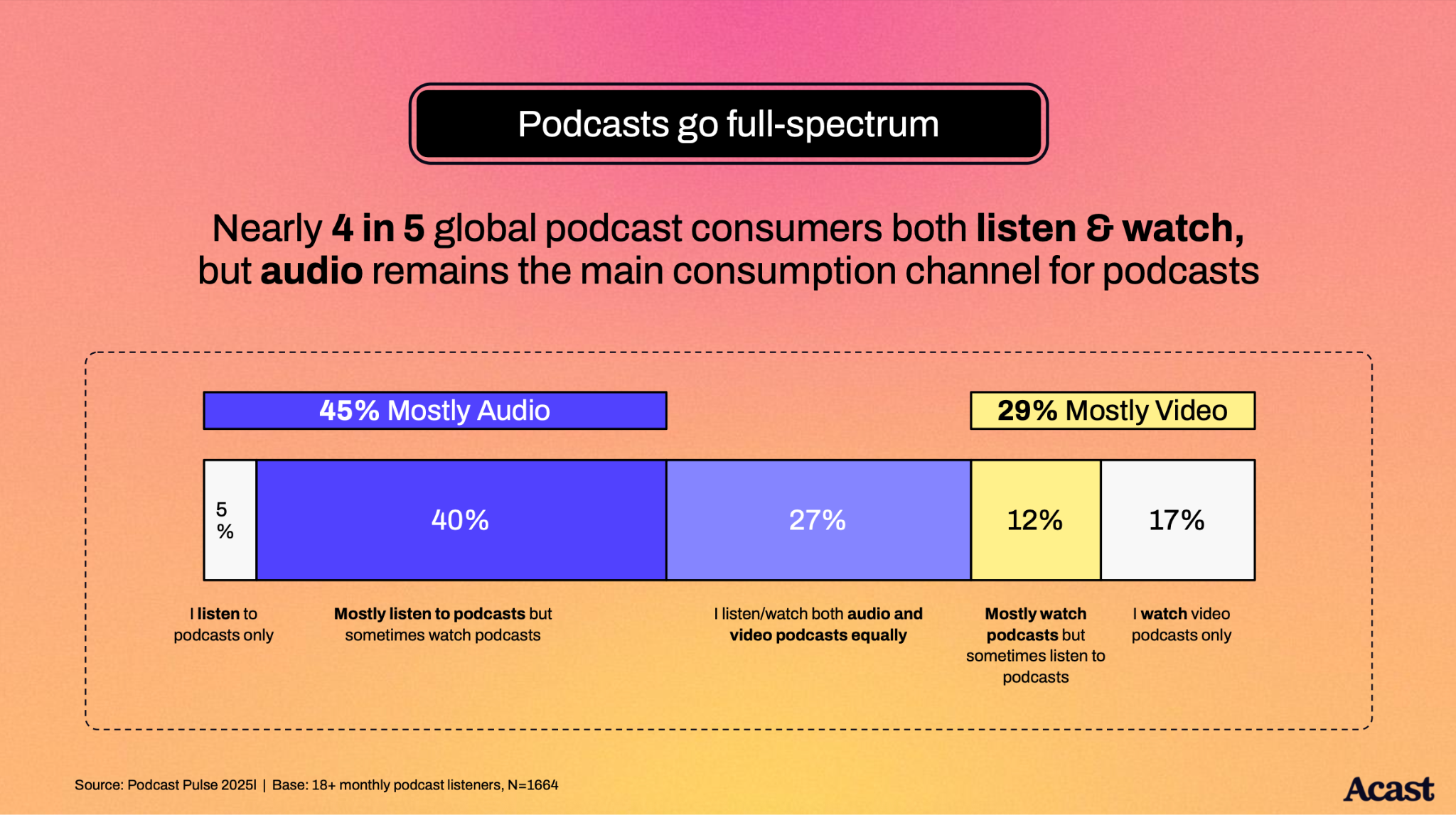
At Acast, we've built for this. We call them quantum ads - the same show, with the right ad experience automatically served depending on whether you're watching or listening. A creator uploads one video file. We extract the audio. We place the markers. And then when a listener opens an app, they get the version that suits how they're engaging with it. Video on, video off. It's a small thing that has genuinely big implications for how we think about the future of the format.
AI Is a Tool. Humans Are the Point.
AI has come up constantly in conversations about podcasting lately, and I want to be clear about where Acast stands.
We use AI extensively - for data analysis, for brand matching, for improving our technology infrastructure. It makes us better at what we do. But we have a clear line: the content has to be made by human beings. Carbon-based, oxygen-breathing human beings.
I think this is actually one of podcasting's most important differentiators in an AI-saturated media landscape. The relationship a listener has with a podcaster is built on the knowledge that there's a real person on the other end of that microphone - someone with opinions, with a perspective, with skin in the game. AI can help us run better businesses. But it cannot replicate that relationship. That trust is human.
The Bigger Thing I Want to Say
I know this next part is a little heavier than the usual keynote fare. Bear with me.
When I started selling radio in New York in 1996, the company I worked for owned 12 stations. Bill Clinton signed the Telecommunications Act that year, which deregulated media ownership. Four years later, that same company owned 1,200 stations. At the time, I thought it was exciting. Now I look back and see it for what it was: the beginning of a consolidation of voice and decision-making that has quietly reshaped public life. The wider media landscape was once competitive - thousands of companies, thousands of editorial voices. Today, five billionaires - not companies, five individual men - control 90% of media in the United States. That's a scary number. And we can see what that looks like in practice.
Podcasting is structurally different from all of that. Think about what actually happens when a creator publishes an episode. The words come out of their mouth, they go into a microphone, and they go directly to the eardrums of their audience. Nobody is in the way. Nobody is telling them what to say, shaping their editorial line, deciding what's acceptable. That direct-to-audience relationship has barely ever existed before in media - not at this scale, not with this kind of reach.
And I think that matters enormously right now. Free speech is under genuine pressure, particularly in my country. Podcasting is one of the few places where someone can open a mic and say what they genuinely think, to an audience that has chosen to be there. It's a meritocracy. The truth - the ideas that genuinely resonate, that hold up under scrutiny - should gain more momentum than the ones that don't. That's how it ought to work.
The people in this industry - creators, platforms, producers, everyone building in this space - have an opportunity to protect something that matters well beyond the commercial case for podcasting. I think we should take that seriously.
Podcasting's future is free-flowing. That's not a marketing line for us at Acast. It's the whole point. Have the conversations. Speak freely. Let the best ideas win.
This is a group of people that can have a real impact on the world. I genuinely believe that.
