The ultimate guide to growing your podcast audience in 2026
How to grow your podcast audience in 2026: the levers that move listens, the metrics that matter, and how one episode becomes 20+ pieces of content.
You grow a podcast audience by building a repeatable system, not by chasing one-off tactics. Publish consistently, book guests whose audiences overlap with yours, cross-promote with similar shows, and turn every episode into social clips that pull new listeners back to the feed. Then measure what happens and put more into whatever moves listens.
That's the short version. The rest of this guide is how to actually do it: the levers that shift the numbers, the metrics worth watching, how to read your analytics without fooling yourself, and how one episode becomes 20+ pieces of content. It's drawn from hundreds of audience-growth tests across Acast shows, so treat it as a strong starting point rather than a rulebook. Every show and every audience is different. Test what fits yours, keep what works.
Acast is the global authority on podcasting. We power the commercial side of more than 140,000 shows worldwide, and this is where we share what those shows have taught us.
How do you grow a podcast audience?
Growth comes from a system that does three things at once: it makes your show easier to find, it gives people a reason to come back, and it keeps opening new doors to listeners who've never heard of you. The tactics below are the ones that showed up again and again in Acast testing. None of them works in isolation. Stacked together and repeated every week, they compound.
Publish on a schedule your audience can rely on
Consistency compounds, and more output means more ways in. For shows that work as standalone episodes, a wider spread of topics catches more people searching for their specific interest. One Acast show that moved from one episode a week to three nearly doubled its weekly listens. The exception is serialised shows, where listeners follow a thread and too much content becomes hard to keep up with. Watch your per-episode average as you scale. Total listens can rise even as the average per episode dips, and that's fine as long as you know it's happening.
Book guests whose audience overlaps with yours
A big guest is only worth it if their audience looks like the one you want. Name recognition opens the door, relevance is what converts. In Acast's analysis, more than half of episodes with a well-matched big guest saw a lift in listens. The same logic runs in reverse when you go on other people's shows: appearing in front of an audience that already listens to your kind of podcast puts you in front of people primed to subscribe.
Cross-promote with shows your listeners already trust
Cross-promotion is the most reliable way to reach people who are already podcast listeners, because you're borrowing trust another creator spent years building. A host-read recommendation, a feed drop, or a promo swap carries an endorsement a cold ad never will. The format matters. US growth specialists report host-read recommendations converting at around 5%, well above a straight trailer swap, because a host telling their audience to go and listen lands harder than a trailer dropped into a feed.
Ride topical moments, but only where you have standing
Tools like Google Trends show you what's rising. That's the easy part. The discipline is staying out of conversations you can't add to. Audiences spot a creator faking interest quickly, so pick moments where you have real knowledge or a genuine point of view. Put the topic high in the episode title, make the title worth the click, and time it to the moment. Political shows publishing through election season saw double-digit growth by doing exactly this.
Show up where your audience is, not where you are
Nearly half of the shows Acast studied grew off the back of a consistent social presence. TikTok and YouTube are discovery engines: their algorithms push content to people by interest, not just by who they already follow, so a single clip can reach someone who's never heard your show. Facebook and Reddit earn their place differently, as homes for community rather than cold reach. Choose platforms by where your listeners spend their time, not by where you enjoy posting.
Build a community, not just an audience
The shows that grow fastest treat listeners as participants. Ask them what they want to hear. Reply to them on social. Put them in the show. Send an email worth opening. People who feel part of something tell other people about it, and a recommendation from a friend still beats every ad you could run.
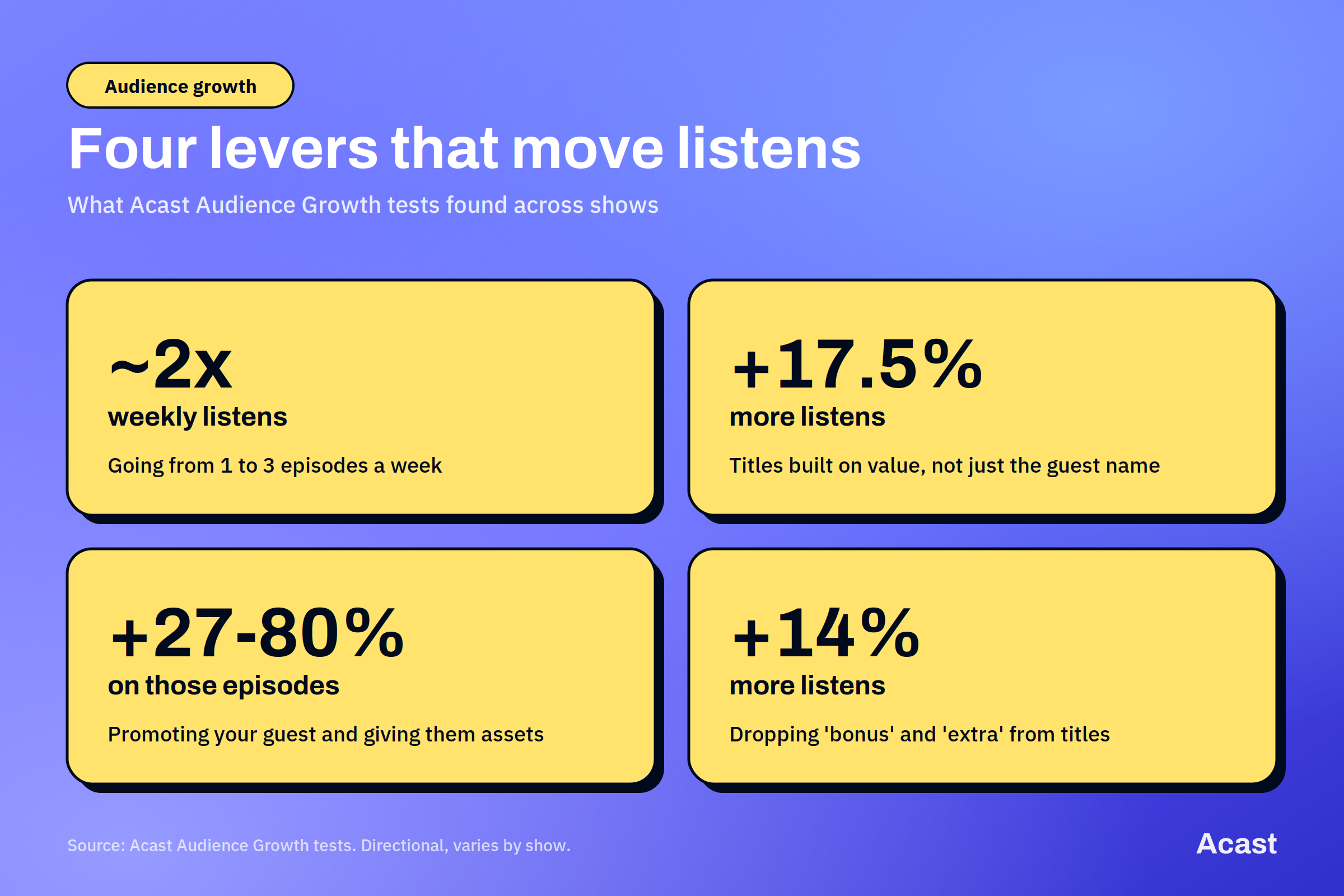
A few of these levers have hard numbers behind them, all from Acast Audience Growth tests. Titles built around the value of an episode, rather than just the guest's name, lifted listens by 17.5%. Dropping "bonus" and "extra" from titles on comparable episodes lifted listens by 14%. And when creators actively promoted a well-known guest, on social and to the press, listens to those episodes rose anywhere from 27 to 80%. Give the guest an asset pack and ask them to post too. It costs you nothing and does most of the work.
One more finding worth its own line: when you target cross-promotion by listener demographic rather than by genre, matching the people rather than the topic, conversions can double.
What podcast metrics should you track?
Track listens, unique listeners, subscriber growth, retention and completion rate, and audience demographics. Read them together, over time. A single number rarely means much on its own. The pattern across several, watched across weeks and months, is what tells you whether you're growing and why.
Core audience metrics
Listens, unique listeners, and subscriber growth tell you the size and direction of your audience. Retention and completion rates tell you whether the content is holding people through the episode or losing them halfway. Demographics such as age, gender, and geography tell you who's actually there, which shapes everything from the guests you book to the markets you push into. Add listening platform, device, and referral source, and you can see where your strongest audiences come from and which channels are driving discovery. For video, views, watch time, and engagement show how people are consuming visual content and which moments hold attention.
Which Instagram metrics should you track?
Instagram is where you turn followers into listeners. Watch reach, impressions, engagement rate, saves, and shares to see what's connecting. Reel views, average watch time, and completion rate tell you which clips hold attention. Profile visits, website clicks, and link-sticker taps tell you whether any of it is sending people toward the show.
Which TikTok metrics should you track?
TikTok is built for discovery, so it's your best shot at reaching people who don't know you yet. Video views, average and total watch time, and completion rate show whether your content is holding attention inside the recommendation algorithm. Shares, favourites, and comments show how hard it's landing. Profile views, follower growth, and click-through rates show whether viewers are taking the step toward becoming listeners.
Which LinkedIn metrics should you track?
For business, professional, or thought-leadership shows, LinkedIn reaches an engaged, specific crowd. Impressions, engagement rate, reactions, comments, and shares show whether your content is starting conversations. Follower growth and profile visits show whether you're building credibility. Check the job titles and industries of the people engaging, because that tells you if you're reaching the audience you actually want.
Which Facebook metrics should you track?
Facebook still works for community and distribution. Impressions, engagement rate, video views, shares, and link clicks show how far your content is travelling and whether it's moving people. Followers, page likes, and recommendations show how your community and its sentiment are growing around the show.
Which YouTube metrics should you track?
For video podcasts, YouTube gives you the deepest read on behaviour. Views, watch time, average view duration, and returning viewers show how people consume your episodes and whether loyalty is building. Subscriber growth and unique viewers show the audience expanding. Thumbnail click-through rate, traffic sources, and the split between new and returning viewers point to where you can improve discovery.
What's the difference between podcast downloads and listeners?
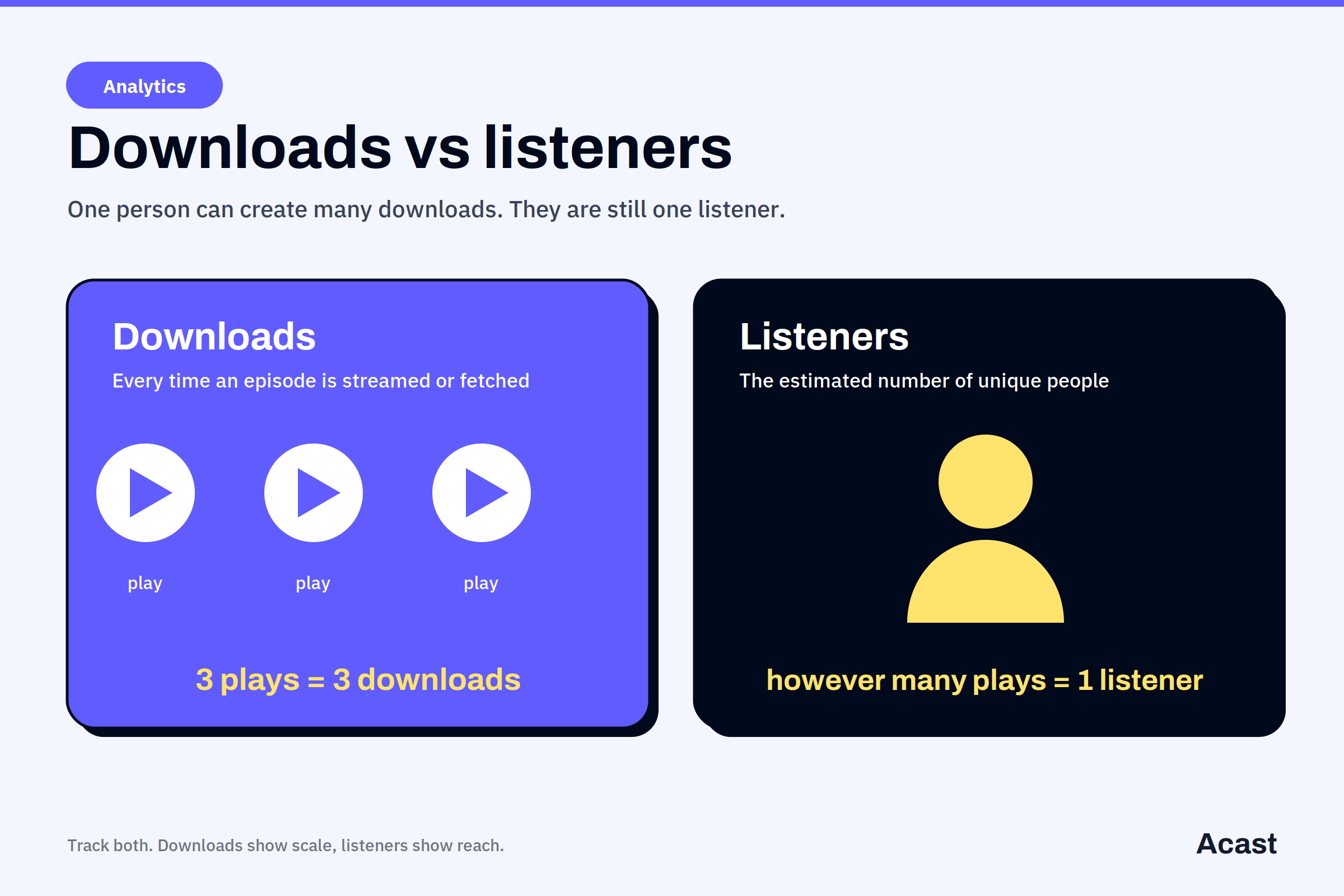
A download counts every time an episode is streamed or fetched, by industry measurement standards. A listener estimates the number of unique people consuming your show. One person can generate many downloads across several episodes, so the two numbers measure different things. Downloads show consumption and scale. Listeners show the true size of your audience. Track both, because each answers a question the other can't.
How many downloads is good for a podcast?
It depends, and anyone who gives you a single number is selling something. A "good" number depends on your niche, your goals, your audience size, and how long you've been going. Comparing yourself to the top of the charts is the fastest way to feel bad about a show that's growing perfectly well. Industry benchmarks and audience percentiles give you rough context, but they swing hugely by category and format. The more useful comparison is against yourself: is the trend up, are people finishing episodes, is the audience engaged. For anyone talking to advertisers, that combination of growth and engagement says far more than downloads alone.
How do you promote a podcast and reach new listeners?
Effective promotion combines the right targeting, real discoverability, consistency, and smart distribution. The single highest-return habit is turning each episode into content that lives everywhere your audience scrolls. After that, borrow trust through cross-promotion, and keep your existing community close enough that they do some of the promoting for you.
Turn one episode into 20+ pieces of content
A repurposing habit is the closest thing podcasting has to free growth. According to a OnePulse 2026 study, 91% of weekly podcast consumers have taken an action because of a podcast clip on social media or YouTube, and half of them went on to listen to a full episode. So the clip isn't a nice-to-have. It's often the first thing a new listener ever sees.
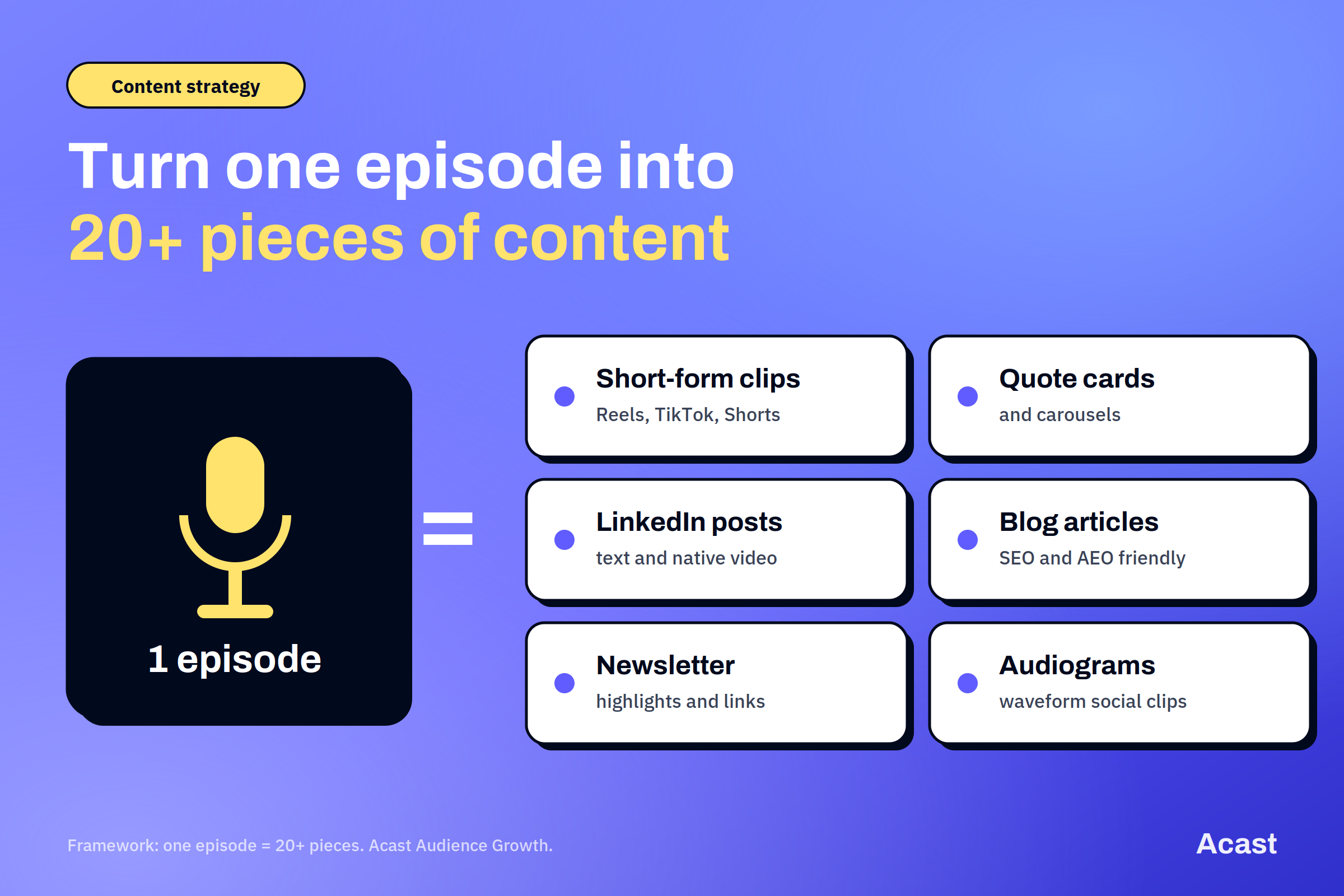
Work to a simple rule: one episode equals 20 or more pieces of content. Pull several standalone moments from each episode, cut them into platform-specific clips for Reels, TikTok, and Shorts, then add quote cards, carousels, LinkedIn posts, a blog article, and a newsletter highlight. Build it into a workflow you run every single time you publish, so reach keeps compounding long after release day.
Put your clips where discovery actually happens
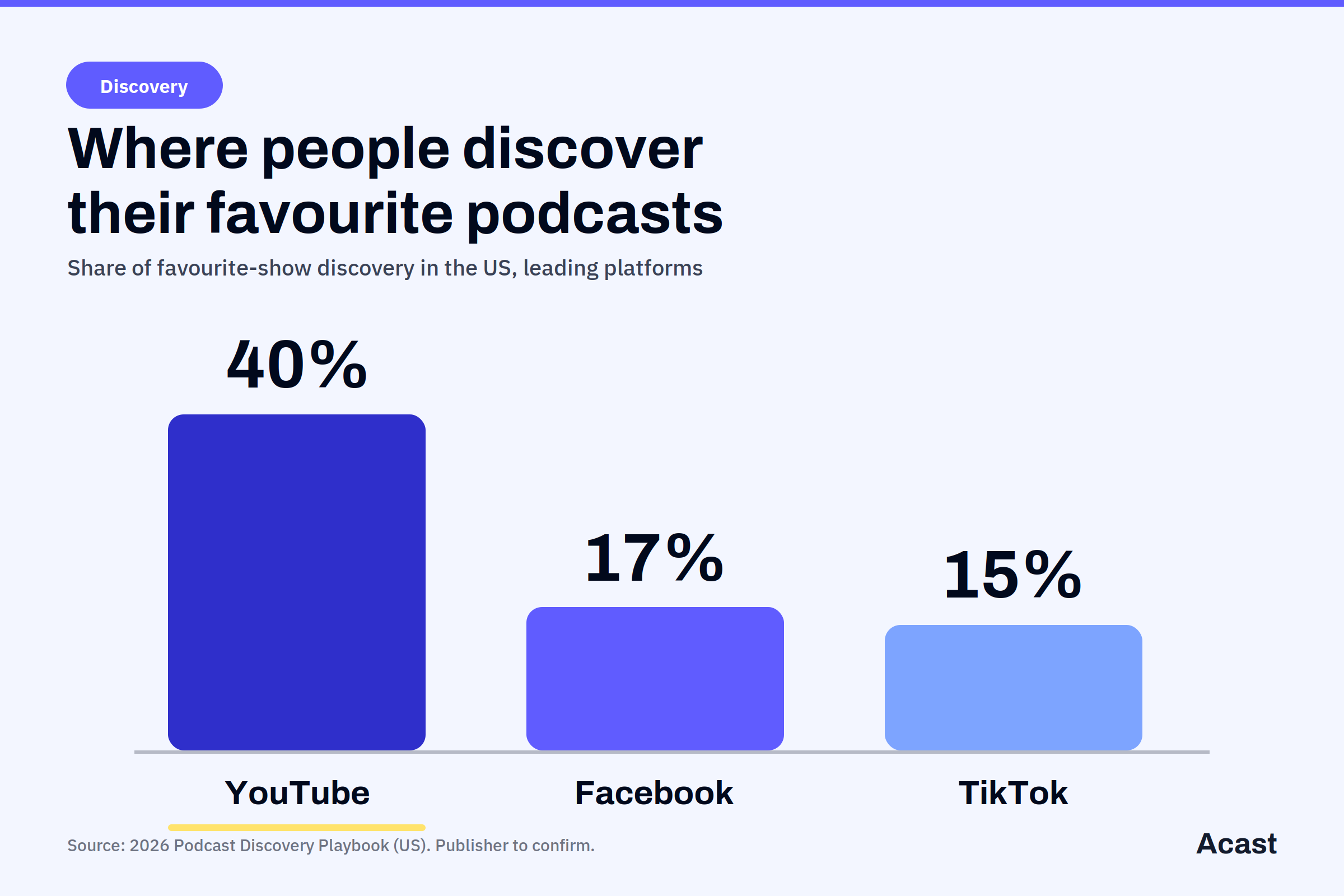
Where you post matters as much as what you post. According to the 2026 Podcast Discovery Playbook, YouTube drives 40% of favourite-show discovery in the US, ahead of Facebook at 17% and TikTok at 15%. Facebook is doing more work than most creators give it credit for, sitting second and making it a real discovery engine for short-form clips, not just a secondary channel.
Clips also earn their keep as ads. 61% of podcast listeners say they discover new shows through advertising inside the podcasts they already listen to, and 66% say an ad that includes music or show clips grabs their attention more than a plain voiceover (Veritonic, 2024). If you promote your show anywhere, use your actual audio.
Cross-promote and, when it's worth it, pay to reach the right listeners
Host reads, trailer swaps, and feed drops with shows whose audience overlaps yours are proven ways to grow. When you're ready to spend, podcast growth and cross-promotion platforms can recommend your show to the listeners of similar podcasts, which sends you a relevant audience rather than a broad one. Target by who your listeners are, not only by what your show is about.
Keep your community close
The best-marketed shows build audiences who market for them. Interact on social, run listener Q&As on the show, ask people what they want next, and bring them into how the show evolves. Over time those listeners become advocates who make and share their own content, and your reach grows without you lifting a finger.
How do you grow a podcast audience internationally?
Global growth starts with being easy to find everywhere, then following the data to the markets already pulling for you. Distribute across every major listening platform, optimise your titles and descriptions for search, and use your analytics to spot the countries where you're gaining traction on your own. From there, collaborate with creators in those markets, tailor your marketing to regional audiences, and use YouTube and social to widen the top of the funnel. The strongest global strategies double down on the markets showing real organic momentum rather than spreading thin across all of them.
Some categories travel better than others. Educational, scientific, and historical content often crosses borders easily, language learning especially, because the value holds wherever the listener is. Comedy can find international audiences, but humour and cultural references are more local. Parenting and similar topics are harder to scale when the advice is tied to a specific country's schools or healthcare.
The proof is in the shows doing it. The Magnus Archives, part of the UK's Rusty Quill network, has just 11% of its audience in the UK this year, and has extended its global reach through a book release and merchandise. Sweet Bobby, a UK true-crime series, built a large international audience and became a Netflix adaptation, which shows how far a strong story can travel across formats. Blindboy, an Irish podcaster with a big UK and Ireland following, now tours internationally, including a headline show at the Sydney Opera House. Universal themes, strong storytelling, and content that isn't tied to local context give a show real reach, and touring, books, and merch turn that reach into a community.
As a genuinely global podcast company with listeners in every country, Acast is built to help here, whether that's a local Creator Manager, pitches to Apple Podcasts, Spotify, or Amazon Music leads in-market, PR and live opportunities abroad, or cross-promotion targeted at listeners in other countries.
Is video podcasting worth it?
For most shows, yes. Video audiences are leaning in: 42% of video podcast consumers plan to spend more time with podcasts over the next year, against 28% of audio-only listeners. They're also more likely to engage with hosts on social, buy merch or donate, and pay attention to host-read ads, especially when those ads run as video.
You don't need a film crew. Start with good audio, add a simple camera, decent lighting, and reliable recording software, and you've got a more immersive show and a stronger identity. An efficient editing workflow lets you cut full episodes and short clips from the same session, and distributing across YouTube and video-capable podcast apps widens your reach. Video costs more time than audio-only, but the extra visibility, engagement, and repurposing usually pay it back.
Acast is making video on Apple Podcasts available to every creator on the platform. In early beta, shows that added video saw an estimated 25% increase in weekly Apple Podcasts sessions, more chances for the same audience to find and engage with the same host. Video isn't right for every show. Where it fits, it's another way to reach listeners wherever they move between watching and listening.
How does podcast distribution work?
Your RSS feed is the source of truth for your show. Every time you publish through your hosting platform, the feed updates with the new audio file, artwork, title, description, and metadata. Directories like Apple Podcasts and Spotify check that feed for changes, so new episodes appear automatically without you uploading anywhere. Understanding your feed helps you keep metadata clean, stay discoverable, and fix publishing issues fast. For step-by-step setup, see how to set up RSS for your podcast.
How do you get your podcast on Spotify and Apple Podcasts?
It starts with a hosting platform, which generates the RSS feed that powers distribution. From there you submit your feed to Spotify for Creators and Apple Podcasts Connect, verify ownership, and make sure your artwork, descriptions, categories, and metadata are complete before you publish. Once approved, new episodes flow to both platforms automatically through your feed. A simple setup checklist keeps the launch smooth and your show discoverable from day one.
What podcast hosts distribute video?
Not every host supports video, so pick one that matches your plan. If video is part of how you'll grow, look for a platform that handles both audio and video feeds, distributes to video-capable destinations, and gives you the storage, analytics, and compatibility to run the workflow without friction. Sort this out before you invest in video production, not after.
How do you get your podcast featured on Apple Podcasts?
There's no guarantee, but you can submit your show and give it the best possible shot. The strongest submissions pair high-quality artwork, consistent publishing, complete metadata, real listener engagement, and content that feels timely or culturally relevant. Editors make the call, so the goal is to make the decision easy for them. Four things help most:
- Submit through the Apple Podcasts promotion request form. Your feed has to be live on Apple Podcasts before you can request a feature.
- Lead with artwork that stops a scroll. If you're featured, it's the first thing a potential listener sees, so make it striking and distinct.
- Optimise your episode title and feed. Skip the episode numbers, say what the episode is actually about, name the guest if you have one, and write for your audience.
- Time it well. Features refresh every Monday, so aim for a moment when your show can stand out: a topical episode, a season launch, or a marquee guest.
FAQs
What's the number-one lever for growing a podcast audience?
A repeatable system beats any single tactic. Publish consistently, book guests whose audiences overlap with yours, cross-promote with similar shows, and keep a real social presence. Run the same playbook every week, measure what moves listens, and put more into whatever works. The compounding is the point.
What podcast metrics matter most?
Listens, unique listeners, subscriber growth, retention and completion rate, and audience demographics. Read them together and over time, never in isolation. One number rarely tells you anything useful. The pattern across several, tracked across weeks, tells you whether you're growing and what's driving it.
Which social platforms should I prioritise to grow my podcast?
Go where your audience already is. YouTube drives the most podcast discovery, followed by Facebook and TikTok, so short-form clips on those platforms reach people who don't know you yet. Use Facebook and Reddit for community as much as reach. Don't spread across every platform. Win the two or three that fit your show.
How do I grow my podcast audience internationally?
Distribute everywhere, optimise titles and descriptions for search, then use your analytics to find the countries already showing traction and double down there. Collaborate with local creators and tailor your marketing to each market. Educational and true-crime content tends to travel especially well.
What's the difference between downloads and listeners?
A download counts every time an episode is streamed or fetched. A listener estimates the number of unique people consuming your show. One person who listens ten times is ten downloads but still one listener. Downloads show scale, listeners show real reach. Track both.
How do I get featured on Apple Podcasts?
Submit through Apple's promotion request form with standout artwork, a clear title that skips the episode number, and good timing. Your feed has to be live on Apple first. Features refresh every Monday, so aim for a topical episode, a season launch, or a big guest.
How much content can one episode become?
Aim for 20 or more pieces. Short clips for Reels, TikTok, and Shorts, quote cards and carousels, LinkedIn posts, a blog article, and a newsletter highlight all come out of a single episode. Build it into a workflow you run every time you publish.
Is video podcasting worth it?
For most shows, yes. In 2026, video audiences spend more time with podcasts and engage more deeply than audio-only listeners. You don't need a big production, just good audio, a simple camera, and an editing workflow that gives you full episodes and clips from the same session.
How does RSS distribution work?
Your host's RSS feed updates Apple, Spotify, and other directories automatically every time you publish, so there's nothing to upload manually. It carries your audio, artwork, titles, descriptions, and metadata. Keep that metadata clean and your show stays discoverable.
Grow your show with Acast
Podcasting with Acast gives you everything you need to grow, distribute, and make money from your show, while you keep full ownership of your content. Industry-leading hosting and analytics, global distribution, dynamic ad insertion, video podcast support, audience-growth tools, and strategic guidance from people who do this all day. We power the business side so you can concentrate on the part only you can do: the show.
Start podcasting with Acast, and turn your influence into income.
